


Interview with Palladium Global Science Award prize winner Professor Natesan Thirupathi
Published on 8 May 2026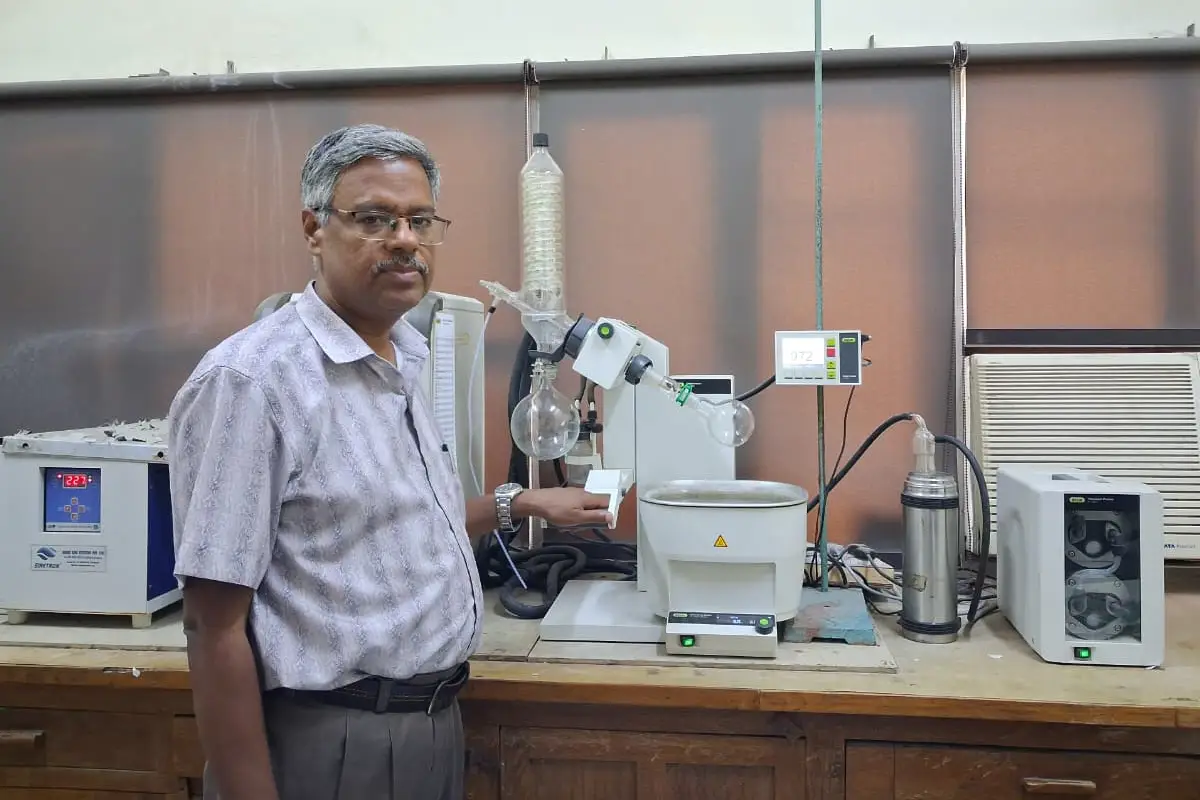
Natesan Thirupathi won the Best Scientific Article nomination in Hong Kong last year, making him one of the first cohort of Palladium Global Science Award prize winners. The Senior Professor at Delhi University received an $80,000 prize for his contributions to organopalladium chemistry. In a wide-ranging interview, we discussed his early career trajectory, the economics of palladium compounds, and the state of scientific development in India today.
Congratulations on winning first place in the Best Scientific Article category at the inaugural Palladium Global Science Award ceremony. How did you first come to specialize in organopalladium chemistry?
Thank you very much for recognizing my contributions to the field of palladium chemistry. In 2003, during my postdoc stint at Case Western Reserve University in the USA, I worked on palladium phosphine complexes which are useful as uni-component latent catalysts for the additional polymerization of norbornene. Further, our team was interested to study how the complexes transformed into ‘Pd–H’ species and the associated kinetics. This endeavour enabled us to prepare a family of tailor-made latent catalysts for norbornene polymerization. This opportunity paved the way for my entry into research on palladium chemistry at the University of Delhi.
Can you tell us a little more about cross-coupling reactions and why they’re so important?
A cross-coupling reaction involves the formation of carbon–carbon bond from an electrophile and a nucleophile in the presence of a base and palladium catalyst. The Nobel Prize in Chemistry was awarded to scientists Richard F. Heck, Ei-ichi Negishi and Akira Suzuki for their contributions to the field of palladium-catalyzed cross-coupling reactions in 2010. Since then, this field has been flourishing as the end products of cross-coupling reactions are important in the fields of medicinal and pharmaceutical chemistry.
Palladium is highly useful, but is associated with high costs per troy ounce. How does your research help to make palladium even more efficient in catalytic processes?
It is true that palladium(II) salts are expensive. However, tailor made palladium(II) complexes or in situ generated Pd(0) species work as catalysts even at a trace level (ppm or ppb level) thus offsetting the high costs. These complexes are tolerant to a wide range of functional groups. Further, both Pd(II) and Pd(0) species are diamagnetic, making the identification of catalytically active species through NMR spectroscopy feasible.
We have identified a family of palladium complexes ligated by N-aryl guanidines as effective catalysts for Heck and Suzuki coupling reactions. These catalysts are stable to air and moisture, are non-toxic and exhibit a broad substrate scope in coupling reactions.
Your novel palladium application has potentially wide-ranging applications, from industry to healthcare. Which are you most excited about?
Yes, palladium complexes are useful not only in industry and healthcare but also in fundamental inorganic chemistry. Presently, we are focusing our attention on utilizing chloro(hetero)arenes as one of the substrates in aryl–heteroaryl, heteroaryl–heteroaryl, Suzuki–Maiyaura and Sonogashira coupling reactions. These reactions are challenging in that the catalysts could be poisoned by the heteroatom in the substrates and hence one needs to be careful in designing the catalysts. Further, these substrates are highly polar and exhibit poor solubility in organic solvents. Lastly, heteroatom-containing biaryls and alkynes are very useful in the fields of catalysis and drug development.
We’re at a critical point in the transition to a green economy. What other developments in palladium technologies are you following at the moment?
In cross-coupling reactions, palladium complexes ligated by electron rich phosphines and carbenes are shown to be successful catalysts. However, these complexes are sensitive to air and moisture, expensive and sometimes toxic. We have been working on palladium complexes ligated by electron rich and tunable N-aryl guanidines which exhibit catalytic activity closer to palladium–phosphine and palladium–carbene complexes in cross-coupling reactions. Our palladium complexes are cost effective, non-toxic and stable to air and moisture. Presently, we are exploring the scope of our catalysts in the cross-coupling reactions mentioned above.
Is the Indian government creating a favourable environment for collaboration between research institutes, universities and business? Has this changed in the last five years?
Yes. The Indian government encourages researchers to engage in collaborative work with scientists across the globe through the creation of various research schemes. The Anusandhan National Research Foundation (ANRF) and the Council of Scientific and Industrial Research (CSIR) are a couple of funding agencies worth mentioning. The government has also initiated a public–private partnership for research and development in the country.
Congratulations on your $80,000 prize once again. How will your achievement affect your research going forward?
Thank you very much. I would like to acknowledge the Palladium Global Science Award committee for recognizing my contribution to the field. This award encourages me to take up even more challenging projects which will be useful not only for industry and healthcare, but also for fundamental inorganic and organic chemistry in addition to catalysis.
What about the Palladium Global Science Award itself? What sparked your initial interest in the competition, and what impact do you think these kinds of initiatives can have?
When I came to know about this award last year, I thought there was a fair chance for me to win the award as I have been working in the field of palladium chemistry since 2003. This award is now well known across the globe thanks to social media and other outlets. Several scientists in India with whom I met recently are keen to participate in the competition. I am sure that this time the Palladium Global Science Award committee will receive far more applications from many eminent scientists and I anticipate that the bar will be higher among the winners of the 2026 edition of the competition.